
by Dan Asenlund

There are many definitions of modernity. While Garon Sheldon defines it as ”progress, science, and rationality,” Steven T. Brown adds ”advanced capitalism and the emergence of market-driven industrialized economies” as well as urbanization to the ongoing discussion about what modernity really means and how it affects us today.
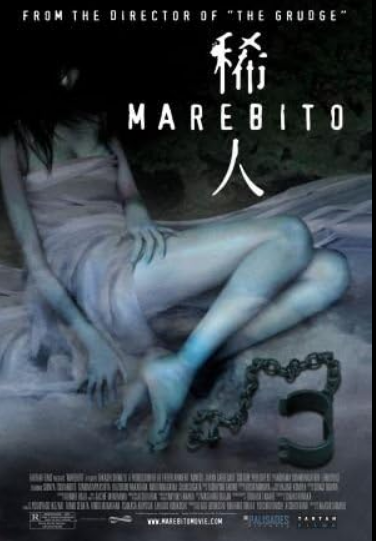
Japan, arguably the world’s leader in the advancement of new technology, is thought by some to be the greatest sufferer of modernity. With its unique social traditions and cultural values, the clash between the old and the new, the modern and the un-modern, is almost as strong as the impact of an atomic blast. In this essay, I will argue why the recent Japanese horror films Marebito (Shimizu Takashi, 2004) and Kairo (Kurosawa Kiyoshi, 2001) portray a negative view of today’s Japanese society, with the effects of modernity acting as the trigger to insanity and even to the Apocalypse itself.
But before I delve into that, I would like to mention that the topic of modernity is not a new feature on discussion boards worldwide. As Brown notes, modernity first emerged out of the Age of Enlightenment in 18th Century Europe and America. Japan at that time was still an “un-modern” nation closed to the outside world, but with the Meiji Restoration of 1868 entered a rapid modernization that stunned the West, especially with the victory over Russia in the Russo-Japanese War of 1904-05, the first time an Eastern nation defeated a Western power.
But the introduction of modernity in Japan did not please all. Many people suffered a sort of mental loneliness that modernity brought with it, and a deep gulf was created between the people who supported modernization and those who preferred to live by the old values. A famous example of this kind of personal struggle is found in Kokoro, Natsume Soseki’s classic 1914 novel about a young student of the modern age who meets an older mentor, whom he calls “Sensei,” who originally supports modernization but gradually comes to despise its effects. In the first part of the book, Sensei says: “Loneliness is the price we have to pay for being born in this modern age, so full of freedom, independence, and our own egotistical selves.”
Now, almost a hundred years later, and after another rapid modernization in Japan following the second world war, the same kind of loneliness permeates the lives of many, especially those living in urban metropolises like Tokyo where private space is becoming non-existent. I will now turn to analyzing the films mentioned earlier and see how they support this theory in different ways.
In Marebito, just looking at the background scenery gives us an idea of what director Shimizu and scriptwriter/author Konaka Chiaki want to stress. Dilapidated buildings are mixed with towering skyscrapers, often in scenes where Masuoka feels the most confused and disillusioned. In one instance, Masuoka says in his voiceover that “Our ancestors were more perceptive than us” to a skyscraper background, while at the end of the film Kuroki claims that “We used to be wiser” in a scene shot in what appears to be Yokosuka, with a large modern military vessel clearly visible in the background. It is obvious that Masuoka does not feel at ease living in the modern urban world, even though he himself is a technophiliac in his extensive use of advanced technology such as his endless filming and viewing on his multi-monitor homestation. But Masuoka’s technophilia could be viewed as a technophobic message.
For example, if we look at the status of Masuoka’s family, we can see that it is far from in order. He is divorced from his wife, whom he later kills to feed his daughter with blood. His perception of his family members is twisted – the treating of his daughter Fuyumi as an animal who feeds on blood is a reality to be questioned – but in his monologue Masuoka many times admits to his own insanity. To me, after watching the film twice, it seems clear that he did murder his (ex-)wife and that he in some way held his daughter captive. The phone calls he receives from the “aliens” are probably from his wife’s lawyer or other official people who suspect that Fuyumi is held captive in Masuoka’s apartment.
This entire confusion of personal space is related to modernity in the way the family boundaries have grown larger while the space between people on different sides of the world has grown smaller. As Scott McQuire argues, ”The globalization of telecommunications flow goes hand in hand with the reorganization of the space of domestic life.” This clashes with traditional Japanese values with the family at the center.
The issue of private space should also be related to the “netherworld” that Masuoka explores beneath the surface of Tokyo (or beneath the surface of his subconscious, if you want). It could be argued that the netherworld represents the anti-modern, or a place for people (such as Kuroki, who commits suicide to escape the terrors that haunt him in the regular world) to escape the modern world. The darkness and surreal characteristics of it could perhaps be an indication that today there is really no escape from modernity. Interesting to note is that the road to the netherworld leads through some kind of underground factory (representative of modernity). Masuoka also says at one point to Kuroki that he does not think of himself as very different from the under-dwellers in the netherworld, hinting at his despise of the outside world.
In Kurosawa Kiyoshi’s Kairo, the result of modernity is depicted in a different, more cataclysmic way. Instead of showing its effects on individual sanity, Kairo portrays a somewhat dystopian modern society culminating in the apocalypse itself (in powerful scenes that remind of Hirayama Hideyuki’s beautiful drama Taan).
Like Sensei in Kokoro, the characters in Kairo feel trapped in their own loneliness (symbolized by Harue as she hugs herself before dying) and end up committing suicide. Computers and the Internet represent modernity, again symbolizing the issue of shrinking personal space and loneliness. While we can connect with people all over the world in an instant, we become capsuled inside our own individuality, increasing the distance between ourselves and our geographically close ones, such as our families and neighbors. In Kairo, none of the characters seem to have close relationships with their families, and two of them even talk openly about their disconnection with them.
Another interesting issue brought up in the film is that of our world being overcrowded with ghosts. There are many ways to look at this. It might be a literal reference to the actual overcrowding taking place in modern Japanese urban centers such as Tokyo or Osaka. It could also be seen as “uncanny technology” overcrowding us, or perhaps as ghost victims of modernity who have had enough and come back to remind us all about where our society is heading, organizing the kind of apocalypse the film ends in. As director Kurosawa said in an interview, his depictions of the apocalypse should not necessarily be seen as something bad. “Many people construe those images and ideas as negative and despairing, but I actually see them as just the opposite – as the possibility of starting again with nothing; as the beginning of hope.”
A minor but nevertheless interesting detail to note in Kairo is a long-take of a group of friends shot from outside an ice cream shop window, the name of the store clearly visible to the audience: “Sweden.” I don’t know if this choice of location is a coincidence or not, but if we look back at advanced capitalism as a form of modernity, we could look at Sweden to find a less extreme version of capitalism than what is operating in Japan or in the United States.
Other references to modernity are everywhere to be found. Like in Marebito, dilapidated concrete buildings and factories play a big part in the narrative of Kairo. And I don’t think it is a coincidence that we see the majestic skyscrapers of Shinjuku’s business district in the background of the scenes from the greenhouse roof, where much of the drama takes place.
Another thing that the two movies have in common is the use of eerie sound design. In Marebito, the sound of the Deros is very creepy and inhuman. In Kairo, strange sounds surprise us every once in a while, often in connection to machinery or old dilapidated buildings. In a way, we can say that the sound of modernity in these two films is comparable to the sound of impermanence as reflected by the temple bells in the opening line of the Japanese classic novel The Tale of the Heike, which reads: “The sound of the Gion Shoja bells echoes the impermanence of all things.”
In comparing the two films and their approach to modernity, we have noted that Marebito tells the story of a disillusioned man cursed by the effects of modernity. In a way, the effect of mise en abîme (a whole within a larger whole) is present here on many levels. More literally in that what Masuoka is filming works as a story within the story, but also on a deeper level as Masuoka’s anomalous world is part of a larger whole – that of humanity’s struggle to find its identity and personal space in today’s technology-driven society.
In Kairo, a viral horror film that affects many characters’ lives, mise en abîme is present as well. For example, in the scenes inside the computer lab, Harue shows Kawashima a program one of the graduate students has made, depicting dots that represent humans: if they get too close to each other, they die. Later in the film, something uncanny is going on inside the program, where the dots take on ghostly characteristics and collide one after another, in what serves as a smaller whole of what is going on in the main narrative. [Even the title itself represents mise en abîme, as the Japanese character Kai (回) shows, although I am sure that is nothing more than a coincidence, as Kairo (回路), “circuit,” is more relevant here.]
Despite their differences in approach, it can be argued as shown above that both Marebito and Kairo portray a society whose inhabitants suffer from the effects of modernity, finding themselves all alone and cut off from regional communities that in the past used to support them. As Kurosawa Kiyoshi says, “A human being, isolated amidst a huge aggregation of people and information systems, [still] remains entirely, entirely alone in this metropolis.”
Whether the apocalypse is the only solution to cure people from the disease of modernity remains to be seen.
© Dan Asenlund, 2006
List of sources:
Garon, Sheldon. “Rethinking Modernization and Modernity in Japanese History,” Journal of Asian Studies 53.2 (May 1994): 350.
Brown, Steven T. “What is modernity? – Towards a Working Definition.”
Natsume Soseki. Kokoro. Translated by Edwin McClellan. Washington, D.C.: Regnery Publishing, Inc., 1957. (30)
McQuire, Scott. “The Uncanny Home: Television, Transparency and Overexposure,” Paradoxa, vol. 3, no. 3-4, 1997. (528)
Kurosawa, Kiyoshi. Quoted in Japanese Horror Cinema. Edited by Jay McRoy. Edinburgh: Edinburgh University Press, 2005. (6)
Selections from The Tale of Genji and The Tale of the Heike. Translated by Helen Craig McCullough. Stanford: Stanford University Press: 1994. (265)
Kurosawa, Kiyoshi. “Emerging Cinema Master – Kiyoshi Kurosawa.” http://www.dvdtalk.com/interviews/004275.html
 Dan Asenlund